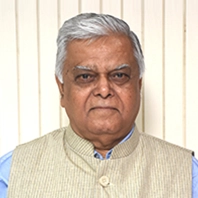
Prof. (Dr.) Charudatta Digambarrao Mayee
Member, Advisory Board
Prof. (Dr.) Charudatta Digambarrao (C. D.) Mayee is one of India’s most distinguished agricultural scientists, plant pathologists, science administrators, and policy leaders. With over five decades of exemplary service to Indian agriculture, he has made pioneering contributions to plant protection, crop disease epidemiology, cotton biotechnology, agricultural research management, and science-based policymaking. His work has significantly influenced India’s agricultural transformation by integrating scientific innovation with sustainable farming practices, benefiting millions of farmers across the country.
Dr. Mayee obtained his higher education in agricultural sciences with specialization in Plant Pathology and dedicated his career to research, teaching, institution building, and agricultural administration. He developed internationally recognized disease prediction models and identified disease hotspots for several economically important crops, particularly in semi-arid regions. His pioneering research in plant disease management and crop protection has substantially enhanced agricultural productivity and resilience in India.
A renowned authority on cotton improvement and agricultural biotechnology, Dr. Mayee played a pivotal role in the scientific evaluation and regulatory approval of Bt Cotton in India. As Co-Chairman of the Genetic Engineering Appraisal Committee (GEAC), he led several landmark initiatives to establish transparent, science-based biosafety assessment protocols for genetically modified crops. His leadership has been instrumental in advancing biotechnology as a key driver of sustainable agricultural development in India.
Dr. Mayee has held several of the highest leadership positions in India’s agricultural research and governance system. He served as Chairman of the Agricultural Scientists Recruitment Board (ASRB), Government of India, Agriculture Commissioner, Ministry of Agriculture, Government of India, Director of the ICAR–Central Institute for Cotton Research (CICR), Nagpur, and Vice-Chancellor of Marathwada Agricultural University, Parbhani. During his distinguished administrative career, he also chaired the Central Insecticides Board and Registration Committee (CIBRC) and served on numerous national committees responsible for agricultural research, biotechnology regulation, and human resource development.
Even after his retirement from government service, Dr. Mayee continues to contribute actively to agricultural innovation and policy. He currently serves as President of the South Asia Biotechnology Centre (SABC), Vice President of the National Academy of Agricultural Sciences (NAAS), Chairman of AFC India Ltd., and Advisor to the Agrovision Foundation. Through these roles, he continues to promote cutting-edge technologies, climate-resilient agriculture, precision farming, biotechnology, and farmer-centric innovation across South Asia.
An accomplished researcher and mentor, Dr. Mayee has authored numerous scientific publications and guided research in plant pathology, crop protection, biotechnology, and agricultural policy. His scientific leadership has earned him national and international recognition, including the FICCI Distinguished Lifetime Contribution Award, the ICAC Researcher of the Year Award, the Annasaheb Shinde Award, the Padma Bhushan Dr. Karmaveer Bhaurao Patil National Award, and several Lifetime Achievement Awards. He has also received honorary doctorates and has served on international scientific organizations such as ISAAA and the African Biosafety Network of Expertise (ABNE).
As a Member of the Advisory Board of the Sharad Pawar Inspire Fellowship, Prof. (Dr.) C. D. Mayee brings unparalleled expertise in agricultural science, research leadership, innovation, and public policy. His lifelong commitment to scientific excellence, technology-driven agricultural transformation, and farmer welfare provides invaluable guidance to the Fellowship’s mission of nurturing future leaders in Agriculture, Education, and Literature, fostering innovation, evidence-based thinking, and sustainable rural development.